Origin
The Bullmastiff was created in England in the late 1800s by gamekeepers who wanted to protect their estates from poachers.
The gamekeepers' dogs had to be very couragious and tenacious to be able to catch and hold the poachers who used every means and devices to escape, since punishment for poaching was hanging.
These dogs were known as Gamekeeper's Night Dogs and are the ancestors of today's Bullmastiffs.
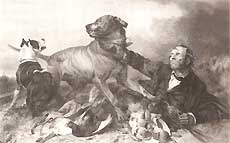
The Poacher of 1865 by Richard Ansdell
depicting a poacher caught by an early Bullmastiff / Old English Mastiff
Collection The Dog Museum. St. Louis
The breed takes its name from its two parent breeds, the Bulldog and the Mastiff. Bullmastiff breeders in the US, favored a slightly higher percentage of Mastiff blood (60% Mastiff, 40% Bulldog), while the British fanciers kept close to a half-Mastiff, half-bulldog combination.
It was created to be faster and more aggressive than a Mastiff, while less savage than a bulldog (of those days). The outcome had to be as loyal of the Old English Mastiff, which was reputed to have roamed only his master's property, never trespasing its bounderies.
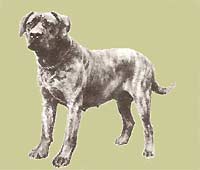
Ch. Farcroft Silvo, the first Bullmastiff Champion ever
Won CRUFTS 1927 and 1928
The breed received official recognition by the Kennel Club in 1924 and by the AKC in 1933. From then on a distinction is made between cross-bred bullmastiffs and pure-bred bullmastifs (those with at least three generations of Bullmastiffs).
The breed was further standardized by S.E. Moseley who is considered the father of the modern Bullmastiff. One of his Bullmastiff bitches, Farcroft Silvo, became the first champion of the breed.
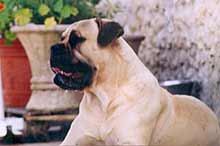
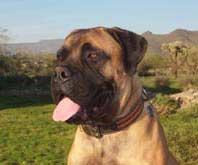
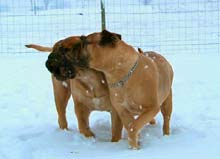
The Bullmastiff looks like a Mastiff with a Bulldog's head and is interdmediate in size bewteen the two breeds. It has a strong, muscular body structure, without being too heavy.
Paprika de Molossie and
Annikka Blackslate de Molossie
The skull reminds the bulldog ancestry. It is very broad and square and its circumference can equal the dog's height at the withers. The stop is very marked and the muzzle is shorter than that of a Mastiff.
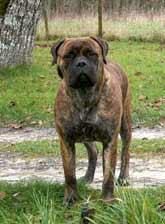
Originally dark brindles were favored as dark colors were preferred for night work as a guard dog. These dark colors progressively gave way to fawns. Today any shade of brindle, fawn or red is accepted, with or without a slight white marking, but only on the chest. The muzzle is black.
Pénélope de Molossie
Kennel de Molossie
Despite his ferocious outlook, today's bullmastiff is surprisingly quiet and docile/ However, it has lost none of its power and determination when it has to defend his family or home. Otherwise, the Bullmastiff is very playful and always eager to learn something new.
.
.
.
.
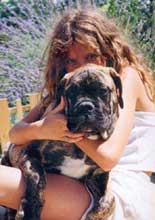
Bullmastiffs are usually very dependable with children, but should nevertheless always be kept under supervision by an experienced dog person due to their powerful structure.
An excellent dog for those who want a molosser breed but do not have the space to keep a giant breed. Bullmastiffs bark less and will not need as much exercise as some other, more excitable, guard dog breeds.
Original idea, design and development by C. Marien-de Luca. Photos of the Dog Breeds of the World sphere of flags by Mark Stay.
No part of canininformationlibrary.com may be copied, distributed, printed or reproduced on another website without the owner's written permission.
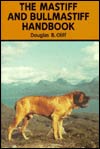
Mastiff and Bullmastiff Handbook
(Hardcover)
by Douglas B. Oliff
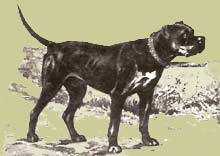
Gamekeeper's Night Dog
From Les Chiens D'Arrêt 1890
Collection Dr. Fleig
Neko
Photo by Terry Bouvier
Character and Temperament
Snake Hazienda High Chapperal
Photo: Kennel de Molossie
References:
Dog Painting 1840 - 1940 A social history of the dog in art by William Secord
Der Bullmastiff by Dr. Dieter Fleig & Herbert Siebold, in Molosser by Walt Weisse u.a., 1999, Mürlenbach/Eifel: Kynos Verlag.






 Home
Home Dog Breed Finder
 Dog Breeds A to Z
 Bulldog Breeds
 Molosser Breeds
 Terriers
 Hunting Dogs
 Flock Guard Dogs
 Water Dogs
 Hypoallergenic Dogs
 North American Dogs
 British Dog Breeds
 Scandinavian Dogs
 German Dog Breeds
 Turkish Dog Breeds
 Asian Dog Breeds
 Chinese Dog Breeds
 Japanese Dog Breeds
 Russian Dog Breeds
 Finnish Dog Breeds
 Hungarian Dog Breeds
 Swiss Mountain Dogs
 Romanian Dog Breeds
 Laika Breeds
 Sled Dogs
 Guard Dogs
 Hairless Dogs
 Ridgeback Dogs