About twenty one clearly indentified dog breeds are of Russian origin. These dog breeds are usually working dogs, including sled dogs, hunting dogs, sight hounds, herding dogs and livestock guard dogs. However, Russia has also produced two terrier breeds and three hounds and spaniel breeds. Some of the Russian dog breeds have gained international recognition, while others like the Moscow Toy terrier are still relatively unknown abroad.
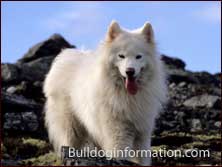
The Samoyed takes its name from the people that developed the breed, the Samoyede people of Northern Siberia.
Originally a reindeer herd and guard dog, they were occasionally also used for pulling sleds and are still today. Today's Samoyed retains many of its original traits.
Samoyed
It is believed that all Samoyeds in the West descend from 12 dogs imported to England by fur traders and explorers at the end of the 19th century.
From England Samoyeds were taken to the United States, but due to the UK's quarantine laws very few dogs were imported back to the UK. As a result, two slightly different strains evolved, with the English type favoring good heads and excellent coats, while the American type has better movement.
The Samoyed is not aggressive, and makes a reasonably good watchdog. They have a great affection for their human family.
Northeasterly Hauling Laika: a hardy and reliable sleigh dog common in the extreme eastern part of Siberia, as well as some of the Arctic isles. See Laika breeds of Russia.
Siberian Husky (Siberian Chukchi, Arctic Husky): one of the most ancient and purest of all the northern sled dogs. It is also the smallest and fastest of all sled dogs. The etymology of the word 'husky' is not clear; it is either a mispronounciation of chukchi, a local tribe of the extreme north-east of Siberia were this breed was commonly found, or a slang abbreviation of the word 'Eskimo'.
Russian Sighthounds
Tazi:
(also spelled Tazy, Tasy, Tadzi, Taji) A sighthound similar to the Saluki, but more strongly built and mainly found in the Kirbiz steppe country. It is a courageous dog used for the hunting of bare, fox, gazelle, wildcat and marmot.
There are two local varieties: the Khazakh Tazi and the Turkmenian Tazi. The Tazi is smaller in size than the Greyhound and Russian Greyhound: the Kazakh variety measures 60-70 cm at the withers, while the Turkmenian Tazi measures less than 60 cm.
Unlike English Greyhounds, Tazi are best at long distance running. They can reach 65km/hr (40mph) and a speed of 40km/hr (25mph) can be maintained for about 5km (3 miles). Tazis are also said to be better at taking sharp curves compared with English Greyhounds. They are not only fast, but also possesss a strong sense of anticipation, which allows them to run in quite dense thickets without risking collision with the trees and pursue and catch wild animals at high speed in forests overgrown with bushes.
The Tazi has a gentle and non-aggressive temperament and rarely barks.
Taigan:
The Taigan is a very rare Greyhound breed only found in the regions of Kirghises of the Tian-Tshan and probably resulting from a cross between the Afghan and the Tazi. Some consider it the coated version of the Tazi. It is very similar to the Tazi, though with the built and thickness of hair of the Afghan. His distinctive features are his wavy and coarse coat, a relatively short and thin tail, which forms a spiral at the end, and ears that are set deep on the head in contrast to the Tazi whose ears are set at a higher level, sticking out. It is, together with the Borzoi, the only Russian Greyhound with the strength, courage and keeness to hunt the fox.
South Russian Steppe Hound:a white or cream-colored hound, most common in the region of the Russian Caucasus Mountains, the Volga and the Don River, where it is known as the Abk-Taz-eet, or 'white Tasy dog'.
Circassian Orloff Wolfhound: A greyhound similar to the Siberian Borzoi, but with longer legs and a shorter head, with the forehead not so sloping back between the ears and the eyes more open.
Altough long, the coat is not wavy, but lies flat on the body. the coat is longest about the breast and neck, forming a sort of frill. The hind part of the front legs, the thighs, and the lower part of the tail are heavily feathered. The coat color is always dark, black or dark tawny, and fawn on back and other upper parts, shading off into a lighter color on belly, lower thighs and limbs. While widely described in the early 1900s, the interest in this breed faded over the years and little is known about its current situation. Some authors say it is just another name for the Circassian Hare Hound.
Borzoi (Siberian Wolfhound, Russian Greyhound, Russkaya Psovaya Borzaya, Barzoï): an elegant and graceful dog with aloof personality.
Russian Hunting Laikas
Four Russian hunting dogs with a typical Northern type appearance:
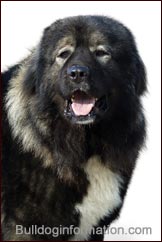
Caucasian Sheepdog Dog (Caucasian Ovtcharka): a powerful dog with a heavy, muscular body and thick coat that protects him against the harsh weather conditions and predators that menace the sheeps it has under its custody. The term ovcharka refers to a flock guard breed, and can also be spelled ovtcharka or owtcharka, according to the transcription system used.
Central Asian Shepherd Dog (Alabai, Central Asian Ovtcharka): described by some as 'the oldest Livestock Guardian Breed in the world'. On authority even believes it 'to be an ancestor of the Tibetan Mastiff'. It is strictly a guardian dog found in Tadzhikistan, Uzbekistan and Kazakhstan. Today, the breed is also popular outside Russia.
South Russian Shepherd Dog, South Russian Ovtcharka (Ioujnorousskaïa Ovtcharka): a giant (of the size of a Great Dane) and amazingly alert breed, descending from the Spanish flock-guard dogs imported to Russia and the local Russian flock guards.
Russian Herding Dogs
Nenets Herding Laika: a medium-sized working dog which owes its name to the Nentsy tribe, an ancient nomad tribe.
See Laika breeds of Russia.
Russian Terriers
Custom Search
Black Terrier (Tchiorny Terrier): a powerful, thick-coated guard dog, specifically created as a military dog for the Red Army. The breeding program was initiated after World War II and involved no fewer than 17 diffferent parent-breeds. See also: Black Russian Terrier.
Moscow Toy Terrier (Moscovian Miniature Terrier): an urban dog, with a lively, playful
temperament. It was probalby created from crosses between English Tory Terriers, Long-haired Chihuahuas and Papillons.
Russian Scenthounds and Spaniels
Russian Hound (Kostroma Hound, Gontchaja Russkaja): a comon and popular scenthound in Russia. Traditionally, it was worked in conjunction with the Borzoi, the sighthounds would chase the game that had been located by the scenthounds.
Russian Harlequin Hound (Russian Piebald Hound): originally called the Anglo-Russian Hound (until 1951), this tricolored dog was created by crossing the imported English Foxhounds with the local Russian Hound. It is intermediate in size between the Russian Hound and the Foxhound. It is considered the ancestor of the Norwegian Dunker.
Russian Spaniel: a small working spaniel, similar in appearance to the Springer Spaniel, but leggier. It is used for its finding, flushing and retrieving abilities in hunting for quail, duck and sandpiper. The breed, however, is not very resistant under rough working conditions.
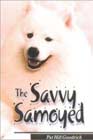
The Savvy Samoyed
(Paperback)
by Pat Hill Goodrich More information:
Hunting Laika Breeds of Russia
(Paperback)
by Vladimir Beregovoy More information:
Desmond Morris
Dogs: The Ultimate Dictionary
of over 1,000 Breeds More information:
Borzoi -
the Russian Wolfhound: It's History, Breeding, Exhibiting And Care
(Paperback)
by Nellie L. Martin
Reprint of the originally published work of 1931 Early work on the russian wolfhound and Borzoi
Extremely rare in its first edition More information:
Northern Breeds
(Complete Pet Owner's Manual.) by Margaret H. Bonham more information







 Home
Home Dog Breed Finder
 Dog Breeds A to Z
 Russian Dog Breeds
 Laika Breeds
 Shepherd & Wolf Dogs
 Scandinavian Dogs
 Asian Dog Breeds
 Chinese Dog Breeds
 Japanese Dog Breeds
 Turkish Dog Breeds
 Finnish Dog Breeds
 Hungarian Dog Breeds
 Sled Dogs
 Guard Dogs
 Terriers
 Hunting Dogs
 Flock Guard Dogs
 Molosser Breeds