Shih Tzu 15 months old with
tradtional coat called for by the standard
Originally referred to as the Lhasa Lion Dog, to distinguish it from the Chinese Lion Dog (the Pekingese), the Shih Tzu appeared around the 17th century in the Chinese Imperial Palace as the descendent from the royal Pekingese and the Lhasa Apso.
It was not before the 1930s that the first Shih Tzu appeared in the West. A black-and-white pair called Hibo and Shu Ssa arrived in England in 1930 and a trio reached Norway in the 1932.
The Shih Tzu Club of England was formed in 1934 and the breed was officially recognized in the UK in the 1940s. Soon interest in the breed also developed in Scandinavia, Austria and other European countries. It was not before the 1960s that the breed reached the US and was recognized by the American Kennel Club in 1969.
An attractive and less time-consuming alternative to the traditional coat is the short terrier-like trim favored by many Shih Tzu owners
Originally, golden-yellow was the favorite coat color, but other colors were permitted as well: solid yellow (Chin Chia Huang Pao), yellow dogs with a white mane (Chin Pan To Yueh), black-and-white dogs (Wu Yun Kai Hsueh), solid black dogs (Yi Ting Mo) and multi-colored dogs (Hua Tse). Today all coat colors are permitted.
Dogs that are in top condition have dense, flowing double caots that sweep the ground and are almost without any curl.
Character and Temperament
Although the Shih Tzu is very similar to the Lhasa Apso it is different in temperament. It is less aloof than its Tibetan ascendent and more playful.
Shih Tzu
(Lhasa Lion Dog)
The Shih Tzu has an extrovert and dignified personality and a vivacious and confident character. This breed will adapt to any family situation.
.
.
.
.
Photos on this page © Global Photographers (Shih Tzu on 15 months old); Sean Breslin (Lion dog statue); Anne Kitzman (Shih Tzu with Terrier-like trim); Darren Fisher (Shih Tzu in cup); Eric Isselée (Shih Tzu on white background). Original idea, design and development by C. Marien-de Luca. Photos of the Dog Breeds of the World sphere of flags by Mark Stay.
No part of canininformationlibrary.com may be copied, distributed, printed or reproduced on another website without the owner's written permission.
The Shih Tzu originated from an ancient cross between the Lhasa Apso and the Pekingese. It is poetically described as having a patchwork of features stemming from animals and objects as different and surprising as a dragon (eyes), a lion (head), a frog (mouth), an owl (face), grains of rice (teeth), palm-leaves (ears), a peony petal (tongue) and a goldfish (mouvement).
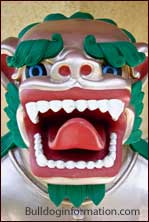
Lion-Dog Shih Tzu statue guarding a Tibetan temple












 Home
Home Dog Breed Finder
 Dog Breeds A to Z
 Bulldog Breeds
 Terriers
 Hunting Dogs
 Flock Guard Dogs
 Water Dogs
 Hypoallergenic Dogs
 North American Dogs
 British Dog Breeds
 Scandinavian Dogs
 German Dog Breeds
 Turkish Dog Breeds
 Asian Dog Breeds
 Chinese Dog Breeds
 Japanese Dog Breeds
 Russian Dog Breeds
 Finnish Dog Breeds
 Hungarian Dog Breeds
 Swiss Mountain Dogs
 Romanian Dog Breeds
 Laika Breeds
 Sled Dogs
 Guard Dogs
 Hairless Dogs
 Ridgeback Dogs