A working dog from Tibet resembling a Newfoundland and originally used as flock guardian dog and caravan guardian.
Tibetan Mastiff
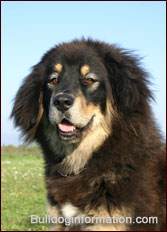
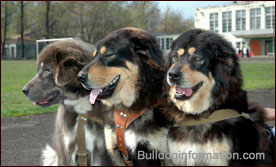
Photo by Cynoclub
Tibetan Mastiff
(Tibetan Dog, Tsang Khyi, Do khyi or Phyu-khi)
The Tibetan Mastiff is considered by some the parent dog from which all modern molosser dogs are descended or the missing link between the flock guard and the molosser breeds.
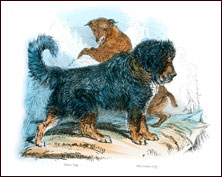
Ancient engraving showing a Tibetan Mastiff and a Wild Indian Dog (Dhole).
At least one type of Tibetan Mastiff was once bigger, as they were once described as being "as big as donkeys". They were also probably more ferocious and aggressive, and much more difficult to train. Like the bandogs of England, these dogs were kept chained up during the day (the name Do Kyui indicates 'a dog you can tie up') and set free at night.
They tended to sleep all day and stay awake all night barking 'to keep evil spirits at bay." This night barking is still a notable characteristic of the Tibetan mastiff. On their travels the Tibetan mastiffs regularly come into contact with the dogs of villagers, with which they interbred. As a result, purebred mastiffs (as most of the other ancient Asian breeds) are quite rare.
An impressive, powerfull and well-muscled dog with a large, massive head and a serious, though friendly expression. The well-plumed and curly tail is carried curled over the back. The coat is of medium length, thick and double.
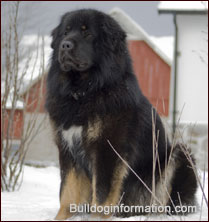
Black & tan is most common is the most common coat color. Solid black is also rather common. Other less common colors are brown, brown&tan, and blue and blue & tan. Grey, red or golden are also allowed.
All colors can have white spots. Actually, a white spot on the chest is desirable, as it signifies a brave heart. Their weigth can reach up to 175 pounds (80kg), although an average of 120 pounds (55kg) is more advisable for a show dog.
.
.
.
.
The Canine Information Library 2003-2009 © All rights reserved.
No part of bulldoginformation.com and dogbreedsoftheworld.org may be copied, distributed, printed or reproduced on another website without the owner's written permission.
Tibetan Mastiffs (brown and black-and-tan)
Photo by Olga Drozdova
Bred for centuries to work on its own, never in interaction with humans, this dog has developed an independent temperament. The breed is also quite watchful and protective. While their tough, protective instincts are still apparent, they are very gentle with their own human family. They are said to be extremely patient with children.
As indicated above, night barking may a problem, especially in certain lines. This breed is not for first time dog owners. Early socialization is important. Training should be structured and fun.
Character and Temperament
Other books that mention the Tibetan Mastiff:
The Atlas of Dog Breeds of the World
However, great variations exist among the different lines of Tibetan Mastiffs and some authors distinguish between two types of Tibetan Mastiffs: a giant, mastiff-type (or Tsang-khyi, 'best dog') and 'smaller' sheepdog-type (or Do-khyi 'tied dog'). Only a few breeders specialize in the giant type today.
Actually, the breed name "Tibetan Mastiff" was assigned by cynologists of the 1800s to a number of closely related breed strains from the Himalayan Mountains. No distinction was made according to size or function.